The next scam text won't work.
Scam warnings tell you to be careful. Scam-Proof trains — printed lessons beside the phone, short practice drills, and lessons that circle back — until spotting a scam is automatic. The scam card is on the refrigerator in week one. Done in months, not forever. For your parent's kitchen counter — or your own.
From a teacher of fifteen years whose own dad still needed it on paper
$249, once. 90-day guarantee. No deadline on deciding.
Free scam advice is on a screen — so is the scam.
The Refrigerator Door
The Kitchen
Anywhere, USA
- Week oneThe scam card is on the refrigerator door. Protection starts that day, before lesson two arrives.
- Every month afterOne printed lesson, one skill, drilled online until the right move is automatic — and checked again next month.
- By the endThe dial-back is a habit, the safe word is set, and the packets stop — because the work is done.
This is the lesson.
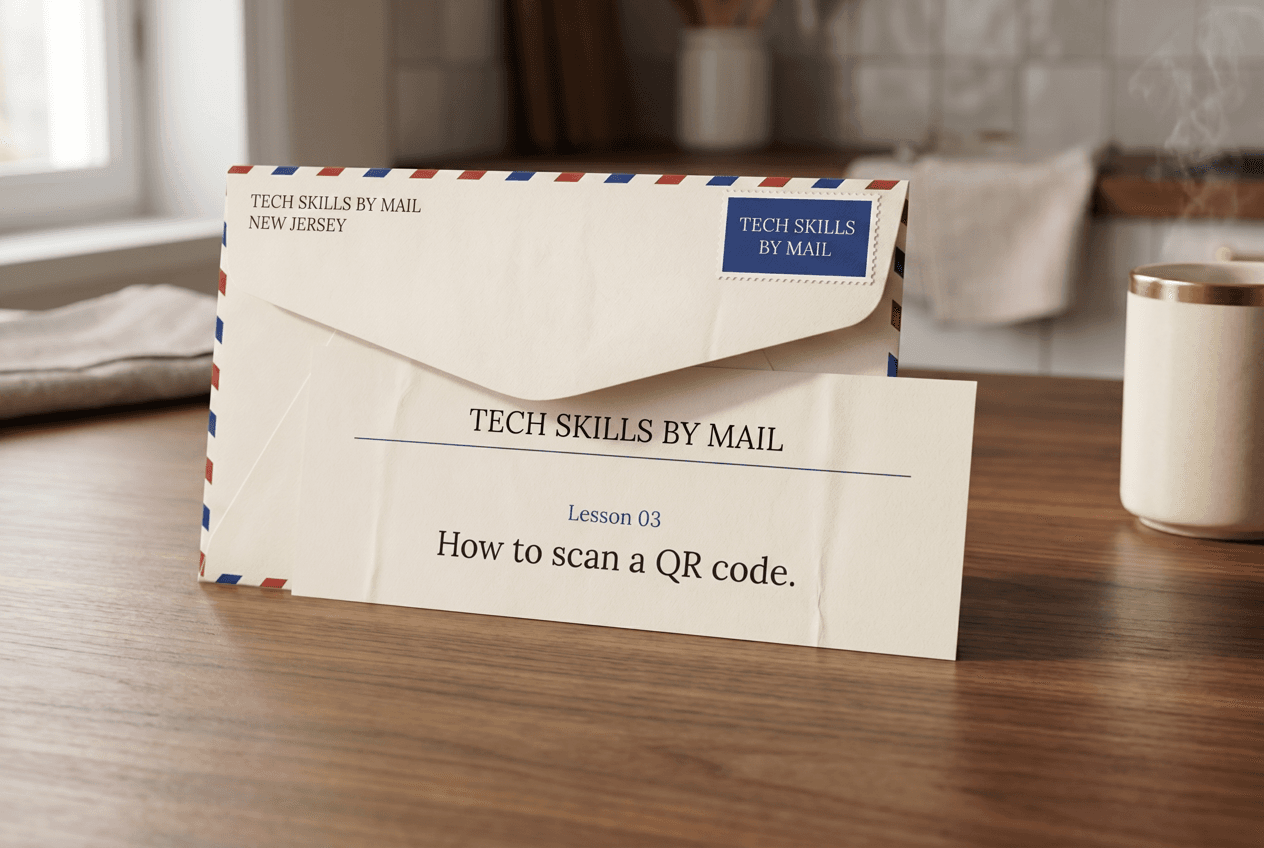
One skill, one path — step by step, nothing skipped, because that's what it actually takes. Big type, full color, one thing to practice. It arrives flat in the mail, hole-punched for a binder, and lives on the kitchen counter — next to the phone, where a defense actually has to work.
Scam-Proof is a complete system — not a stack of tips.
Six parts working together, so a skill doesn't get explained once and forgotten — it gets learned, practiced, checked, and kept. Here's everything that lands on the counter.
Part 01
The Launch Packet
The first envelope: the opening lessons plus printed reference cards — including the scam card made for the refrigerator door. The card goes up in week one, and protection starts before lesson two arrives.
Part 02
Monthly Printed Packets
One packet a month, 30 to 50 pages, big type, full color. One skill. One path. The paper sits next to the phone, so nothing has to be memorized — and paper doesn't close, update, or disappear.
Part 03
The Refinement Layer
Every lesson carries the part most people were never shown: you might already do this — here's what most people miss. So it lands whether you're starting from the first tap or you text every day and never got the rest.
Part 04
Lessons That Come Back
Later packets deliberately resurface earlier skills — next month's lesson checks that this month's skill stuck. Recall, not recognition. That's the difference between nodding at a warning and beating the real text in month four.
Part 05
The Practice Ground
Short online drills, reached by a QR code printed in the lesson — every code with a printed web address beside it in case the camera won't cooperate. Judge the fake texts in a place where nothing can go wrong, as many times as it takes.
Part 06
The Reference Library
Every lesson is built for a binder. By the end there's a manual on the counter that didn't exist before — and the card on the refrigerator works when the phone doesn't.
Stuck on something between lessons? Email me — I'll point you to the exact page, or answer it myself. Email only: no calls to make, no hold music.
What their kids say a few lessons in.
Notes from the people who used to be the help desk — and aren't anymore.
My dad called me three times a week about his phone. Now he video-calls my kids on Sundays — and he's the one who dials. Didn't expect to get a little choked up about it.
Mom swore she'd never get texting photos. The lesson sat on her counter for a week. Now there's a picture of her garden in my phone every single morning.
Bought it half-expecting nothing. Three weeks in, my father-in-law refilled his own prescription online — practiced on the safe copy first. Best money I've spent in years.
My mom went from calling me just to log in to her health portal to viewing her records and scheduling appointments on her own. Now when she has a question, she sends me a screenshot — a two-minute text instead of a twenty-minute phone call trying to figure out what screen she's looking at.
How they practice — without you on the phone
You can't learn tech by reading about it. You learn it by doing it once, successfully, with something next to you that doesn't close, update, or vanish. That's the whole reason this is mail — one skill, on paper, in big type, sitting next to the phone while they work. The lesson goes in the binder when they're done and comes back out when they forget. (They'll forget. Everyone forgets. The paper doesn't.)
Some lessons practice right on the page:
- QR codes come in the very first envelope. A real one is printed on the letter — "point your camera here." When the menu pops up, they didn't read about it. They did it.
- The scam lesson shows a real scam text and asks them to spot what's off — before one shows up for real.
- The dial-back drill rehearses the one move that beats almost every phone scam: hang up, and call back on the number on the back of the card — done on paper first, so it's a habit before it's ever needed.
By the time the harder material arrives — the fake fraud alert, the code that wasn't asked for, the "grandchild" who doesn't sound quite right — the moves underneath it are already built. And later packets return to earlier skills on purpose: next month's lesson checks that this month's skill stuck.
Everything we teach
This is the map of the whole territory — the phone itself, the things locked behind a login, and the parts that make it all worth it. Scam-Proof is the course you start with. The rest is what's coming: full courses in the works, released one at a time.
- Getting around the phoneBigger text, the volume, the flashlight, and the handful of settings that actually matter.
- TextingMessages that go through, photos attached, and group texts without the panic.
- Calls & contactsSave a number, return a missed call, and find the voicemail she's never once checked.
- EmailSend one, find the one that "disappeared," and open the attachment that came with it.
- Passwords & loginsThe password problem, solved once — including getting back into the health portal.
- Scams & safety — Scam-Proof, available nowThe fake text, the fake call, and the new AI-voice scams — trained until the next one doesn't work. This is the course you start with.
- SearchActually find the answer, instead of getting lost three taps in.
- Streaming & TVWatch what they want — the remote, the inputs, the apps, all sorted.
- Shopping onlineOrder it, track it, and do it safely.
- Money & billsCheck a balance, pay a bill — without the fear.
- Video callsSee the grandkids' faces, not just hear them.
NoteScam-Proof is available now. The other courses open as they're finished — Phone Confident, the course for the phone itself, is the next one in the works. Leave your email on the sample-lesson form and you'll hear when each one does; what people ask for most gets built next. And after Scam-Proof, if you want the lessons to keep coming, the guided lesson stream continues month by month across this whole map — $49.99 a month or $499 a year. That comes after. Scam-Proof comes first.
$249, once. Everything else is on the way.
Free videos explain it. None of them let your parent practice it.
That's the hole in every class, every YouTube video, every printout: it can explain how to log in, or spot a scam, or send a photo — but it can't let your parent actually do it. Do it wrong. Do it again. Do it ten times, until it stops being scary. There's never been anywhere safe to practice.
So I built one. Real-feeling sign-in screens, a practice shop, guided texting — mine, not the real bank or the real store — where your parent goes through the exact motions as many times as it takes. Nothing can break. No one is watching. And nothing here is a scam.
That last part is the other half of the point. Rehearsing the real thing is how you learn to spot the fake one. Once your parent has done the honest version — the login that asks for a code the normal way, the checkout that only asks for what it should — the version that asks for too much sets off the alarm on its own.
Practice isn't a separate app to download or a portal to log into. It's built into the lessons — the place to rehearse a skill arrives in the same envelope that teaches it, right when it's needed.
The texting lesson is a good picture of how it feels: a guided back-and-forth, one clear task at a time, where sending a photo or a reply gets rehearsed here first — before it's the real family group chat with everyone watching.
A guided texting exercise, the kind that ships inside a lesson. Works with regular text messages — nothing to install.
The practice login is the one that changes things. You've watched it happen: the bank texts a verification code, and your mom freezes. Is this the scam? Do I actually type this in? So she calls you — every time.
In the practice login she does the whole thing, start to finish: enters a password, gets a code, types it in — on a screen that feels exactly like the real one, except it's mine and it can't lock her out or cost her a cent. She does it on Tuesday. She does it again on Thursday. Then the real code arrives from the real bank — and it isn't a scare. It's something she's already done.
And it's not the only one. Every skill with real stakes gets its own practice ground:
- Practice QR codes — printed right in the lesson. They open pages I built, never a random website, so the very first thing your parent ever scans is a guaranteed-safe one.
- The practice shop — browse, add something to the cart, take it back out, and walk through a real checkout: what's normal to type in, what a real payment screen looks like, and what no honest store will ever ask for. So the real order is easy — and the fake one stands out.
- Practice texting — the guided exercise above: send a message, attach a photo, reply — rehearsed until it's second nature, before it counts.
Every practice ground is tied to the lesson that needs it — no separate app, no password to remember, no homework. It's just there in the envelope, the moment the skill is.
You've read the scam warnings. Everyone has. And the real text still lands different — because a warning builds recognition, and recognition fades by the time it counts. Scam-Proof builds the other thing: practice, on paper next to the phone, drilled until the right move is automatic — and lessons that come back to check the skill stuck. Trained, not warned. That's the whole trick — and it's why it finally holds.
How you'll know it's working.
There's no dashboard, no progress bar, no quiz to grade. It shows up in the household — starting with the scams that stop working. Moments like these:
- A scam text arrives — and instead of getting clicked, it gets forwarded to the family thread with "look what they tried."
- The family has a safe word. Agreed on at the kitchen table, ready long before any call that could need it.
- The phone rings about a "frozen account." The call ends, and the call back goes to the number on the back of the card — the move that beats almost every phone scam.
- The verification code text pops up — the one that used to freeze everything — and it gets typed in without a second thought, because it's been rehearsed a dozen times where nothing could go wrong.
- The health portal opens on the first try — results, appointments, all of it — and this time the login holds.
- A photo of the garden shows up in the family texts one morning. Unprompted. No call first.
- The voicemail from the doctor's office gets found and returned the same day.
- A package ordered online shows up at the door — found, paid for, tracked, with nobody talked through any of it.
None of these arrives on a schedule. They start happening — until one evening you realize the phone hasn't rung about the phone in weeks, and the scam texts have quietly stopped mattering.
What it costs.
Scam-Proof, complete. The launch packet arrives first — the opening lessons plus printed reference cards, including the scam card for the refrigerator. Then one printed packet a month, 30 to 50 pages, with its practice drills online, until the course is finished. Done in months, not forever. Nothing renews unless you ask it to.
Take ninety days with it — counted from the day the first packet arrives, not the day you order. If it isn't right for your household, one call or one email brings a full refund.
Keep everything that's arrived; the card can stay on the refrigerator. No forms to fight, no questions that feel like an interrogation.
For scale: in FTC reports for 2024, the typical loss when a phone scam succeeded was over $2,200 — one course costs a fraction of one bad afternoon.
After Scam-Proof, if you want the lessons to keep coming: the guided lesson stream continues month by month across everything else we teach — $49.99 a month or $499 a year. It's what comes after. It's never where you start.
The whole offer, on one page. No countdown attached.
Why I built this.
I'm Scott. My dad is 79. I walked him through texting a photo more times than I can count — and I build software for a living and taught it, beginner through advanced, for years. Turns out the answer was never more explaining. So I wrote one lesson down, printed it, and left it on his kitchen counter. He never had to ask me how to text a photo again. That's the whole product — now mailed to your parent's door: one skill at a time, and somewhere patient to practice.
Things people ask
What if my parent won't do it?
That's the fear the first envelope answers. Most people who ignore an app don't ignore a letter on the counter — and the very first win doesn't ask for any screen at all: the scam card goes up on the refrigerator, and it's working from that day. Nobody here is bad at this. They were locked out by things that change every six months, and never shown a path back in. Scam-Proof is the path, one step at a time. And if it isn't right for your household, the 90-day guarantee below applies.
Is this too basic for me?
If you already do a lot on your phone: this is placement, not remediation. You won't be parked in a beginner track — the drills exist because practice is what makes an already-capable person automatic under pressure, and every lesson carries the part written for someone who's 60% there: you might already do this — here's what most people miss. You send texts every day. It's the scam text styled like your bank that's built to get past people who send texts every day.
But my mom already knows some of this.
Probably true — and it doesn't change much. "She can text" usually means she can reply to one. The scam text that looks exactly like a delivery notice, the call from a "fraud department," the code she didn't ask for — those are designed by professionals to work on people who text every day. Every lesson meets her where she is: the parts she knows go quickly, and the refinement beats carry the parts nobody ever showed her.
Isn't this stuff free online or from AARP?
The warnings are free, and they're good. But free scam advice is on a screen — so is the scam. Warnings build recognition: you nod along, and by the time the real text arrives, it's faded. Scam-Proof builds competence: printed lessons beside the phone, drills that make you judge fake texts until the tells are automatic, and lessons that come back to check the skill stuck. And the card on the refrigerator works when the phone doesn't — which is exactly the moment free advice can't reach.
What actually shows up, and when?
First, the launch packet: the opening lessons plus printed reference cards, including the scam card for the refrigerator door. Then one printed packet a month — 30 to 50 pages, big type, full color, hole-punched for the binder — with short online practice drills reached by a QR code in the lesson (a printed web address sits beside every code). The packets keep coming until the course is finished: months, not forever. $249, once.
Will this work on my phone — or my parent's?
Yes. At enrollment we ask which phone the lessons are for — iPhone or Android — and the pages match it, button for button. The scam skills themselves work the same on any phone: the tells, the dial-back, the safe word don't care what logo is on the back.
What if a packet isn't finished before the next one arrives?
Nothing bad. There's no schedule to fall behind — the lessons don't expire, they live in the binder, and the drills are there whenever someone comes back to them. Later packets also circle back on purpose: next month's lesson checks that this month's skill stuck. That's the design, not a concession.
What if it doesn't work out?
Take ninety days with it — counted from the day the first packet arrives, not the day you order. If it isn't right for your household, one call or one email brings a full refund, and you keep everything that's arrived — no forms to fight. The full terms are on the terms page.
Ready when you are. Start with Scam-Proof.
Everything is on one page — what arrives, what it costs, how it works, and the enrollment itself. Week one ends with the scam card up on the refrigerator door. Whether that door is yours, or one you visit on Sundays, it starts the same way.
$249, once. 90-day guarantee. Nothing renews unless you ask it to.
See a real lesson first.
You haven't held it in your hands yet. Fair. Give me your email and I'll send a few pages of a real lesson — the big type, one step at a time, the parts most people miss — so you can judge the format before you spend a dollar. You'll also hear when new courses open.
Prefer it done with you? The Digital Setup Intensive is a done-with-you working session — $1,495, a handful of households each month so each one gets full attention. Write to us if that's the right fit.